Suomalaisessa luonnossa liikkumisen ja oleskelun juhlaviikkoa pääsee tänä syksynä juhlistamaan kaikkialla Suomessa, kun Reitistöviikko laajenee kansalliseksi luontoliikuntatapahtumaksi!
Vuodesta 2020 järjestetty Keski-Suomen Reitistöviikko laajenee vuonna 2025 kansalliseksi luontoliikunnan ja -hyvinvoinnin tapahtumaksi. Reitistöviikolla erilaiset ulkoilu-, liikunta ja -matkailureitistöt ovat kaikkien suomalaisten mielessä – ja kovassa käytössä! Reitistöviikko tukee myös alueellisen luontomatkailun edistämistä esitellen luonnossa liikkumisen mahdollisuuksia paitsi oman alueen asukkaille, myös kotimaisille että kauempaakin tuleville matkailijoille.
Jos teidän suunnalla on reitistöjä, niin syyskuussa niistä kannattaa pitää ääntä! Reitistöviikon sivuille on koottu ideoita siitä, kuinka viikolle voi osallistua. Ja omannäköisiä ideoita ja tapoja osallistumisesta voi kehittää itse lisää!
Julkaisemme kevään mittaan myös kaikille Suomen maakunnille oman Reitistöviikko-logon, jonka avulla oman maakunnan reitistöjä ja niihin liittyviä tapahtumia voi esitellä ja markkinoida.
Organisaationa mukaan?
Reitistöviikon poluille ja reiteille voi astua mukaan myös organisaationa. Eli jos teillä on agendalla suomalaisten luonnossa oleskelun ja liikkumisen lisääminen, tai laajemmin hyvinvoinnin tai luontomatkailun edistäminen, niin Reitistöviikko on myös teidän juttu! Osallistuminen velvoittaa vain pitämään ääntä suomalaisen luonnon monista mahdollisuuksista syyskuussa.
Nostamme mukaan lähtevät organisaatiot logoina viikon yhteistyötahoihin. Eli kun päätös mukaan lähdöstä on tehty, niin logoa suuntaamme!
Tervetuloa mukaan tekemään suomalaisen luonnossa liikkumisen tulevaisuutta!
Meijän polku ja keskisuomalaisia lähiluontokonsepteja esitellään juuri julkaistussa Viherympäristölehdessä. Esittelyssä lähiluontokonsepteistamme Luontopysäkit sekä uusi 3–30–300 -luontosuositus. Alkusyksystä ilmestyy samassa lehdessä hieman syväluotaavampi artikkeli Meijän polun seikkailuista Keski-Suomessa, Suomessa ja hiukan jo maailmallakin.
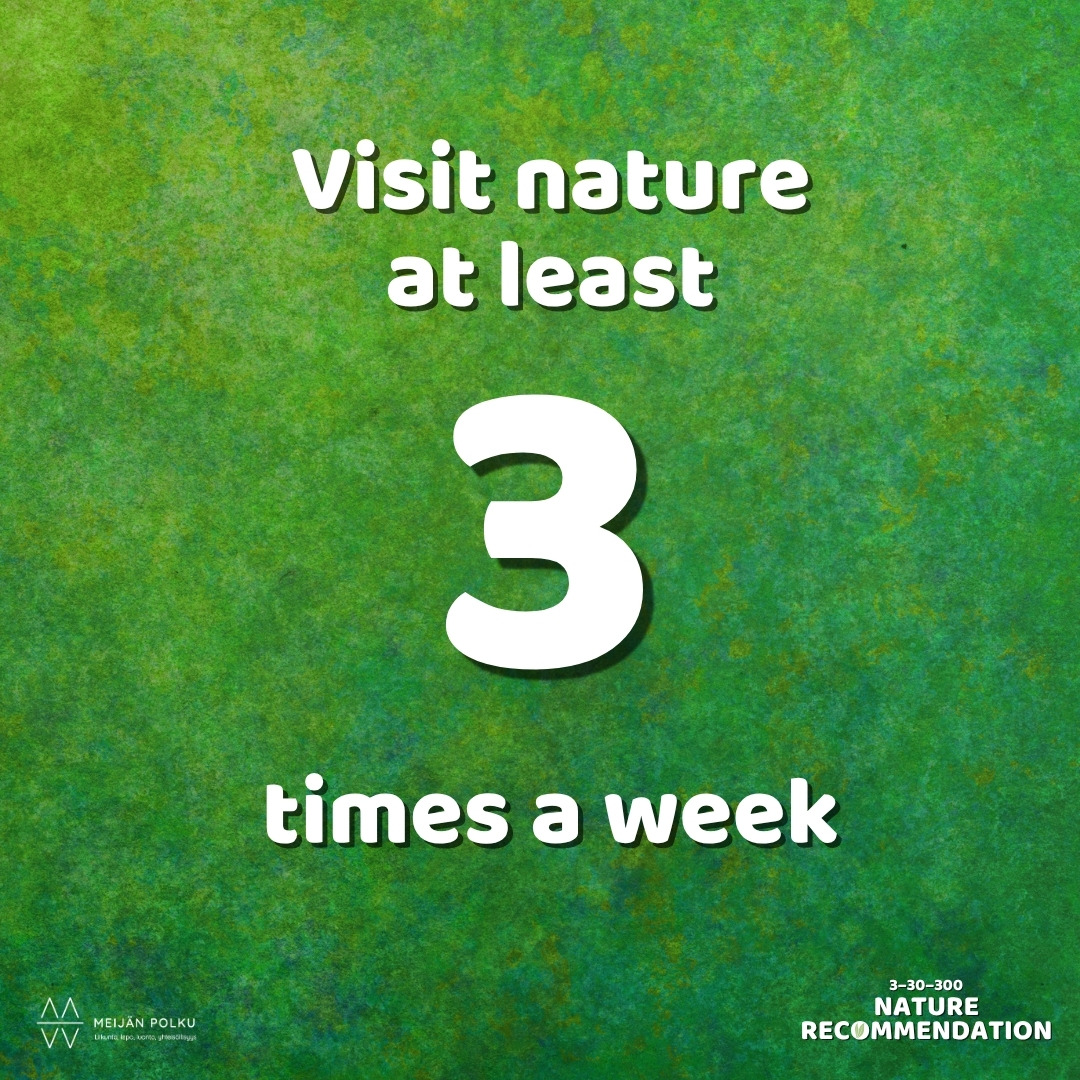
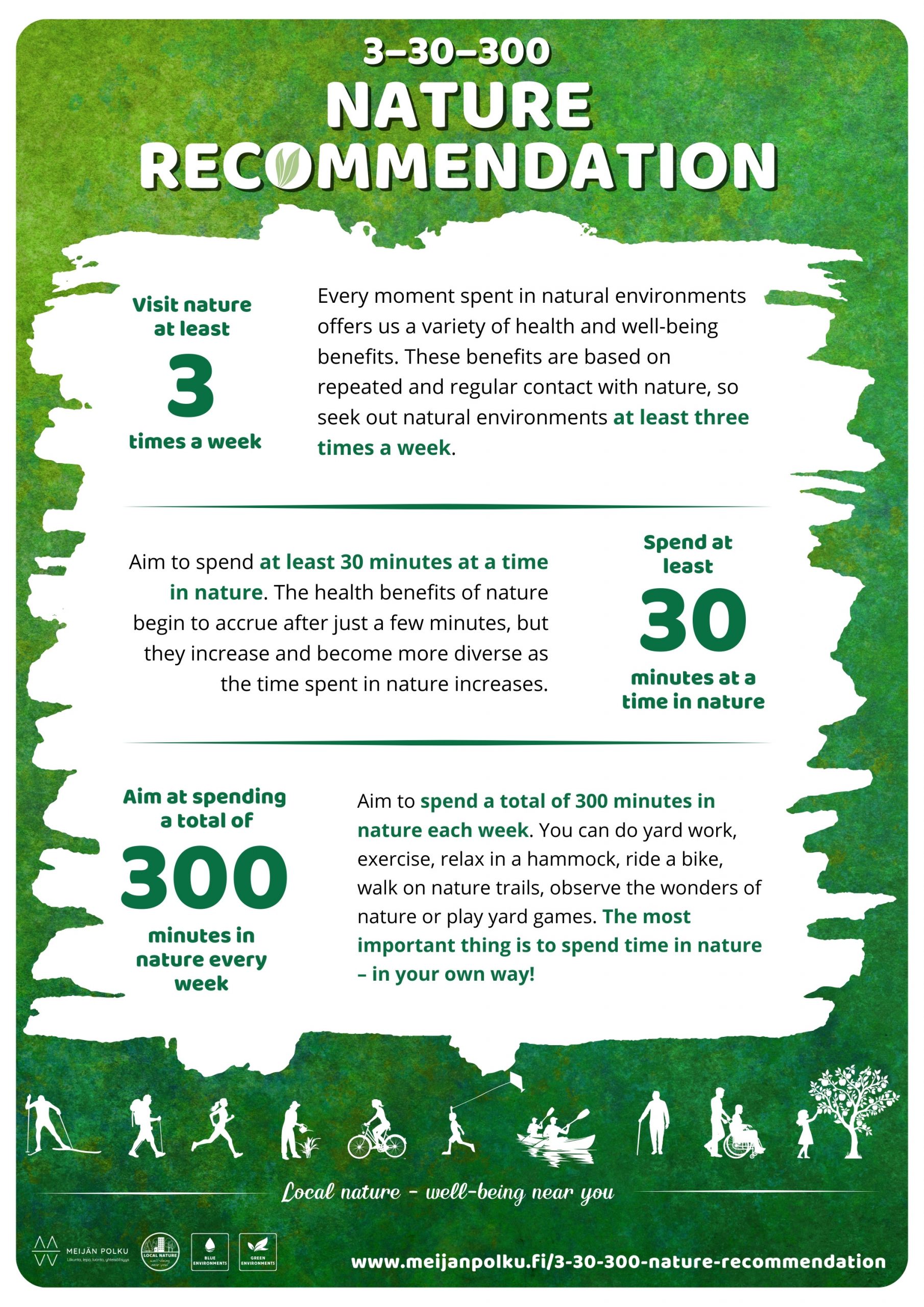
Every moment spent in natural environments offers us a variety of health and well-being benefits. These benefits are based on repeated and regular contact with nature, so seek out natural environments at least three times a week.
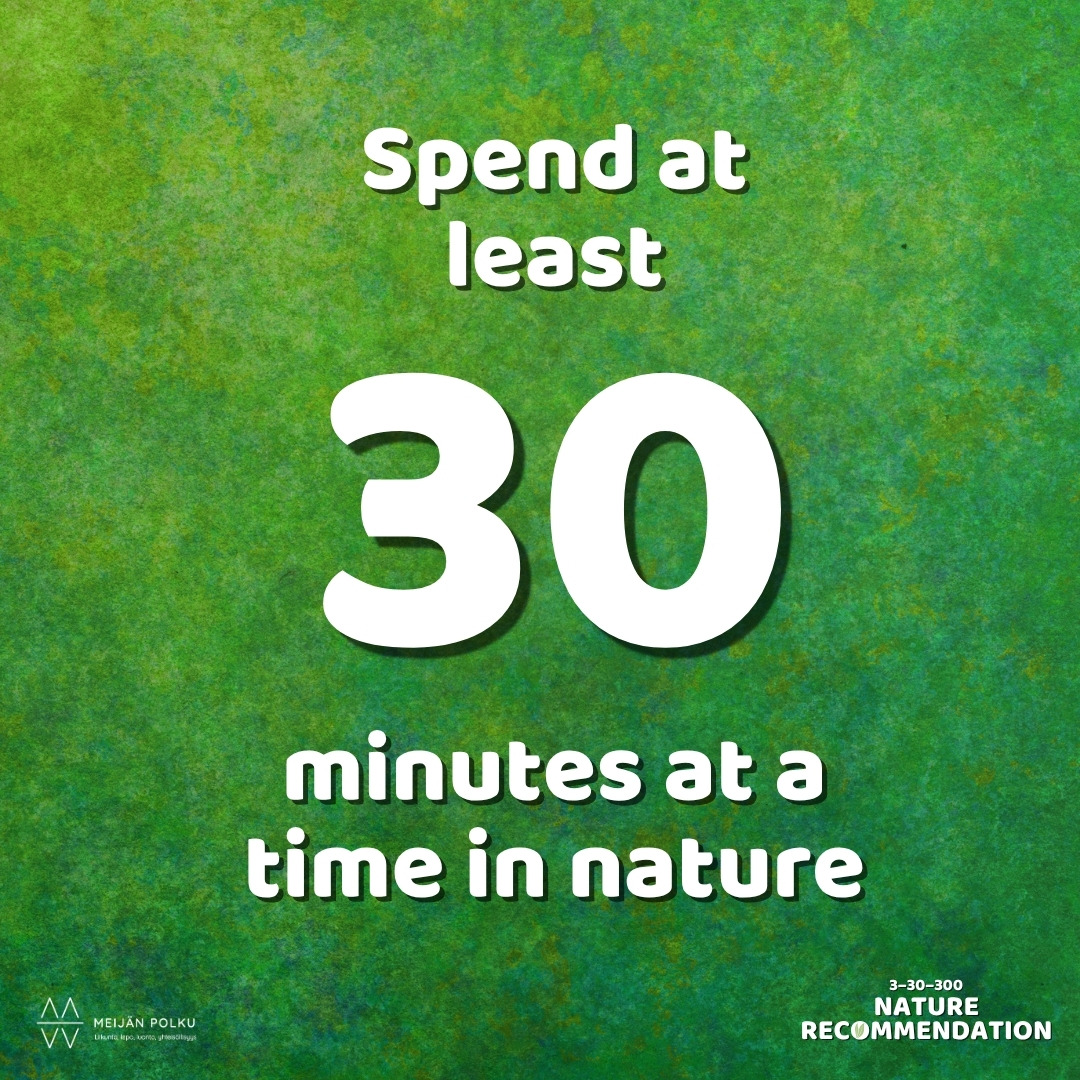
Aim to spend at least 30 minutes at a time in nature. The health benefits of nature begin to accrue after just a few minutes, but they increase and become more diverse as the time spent in nature increases.
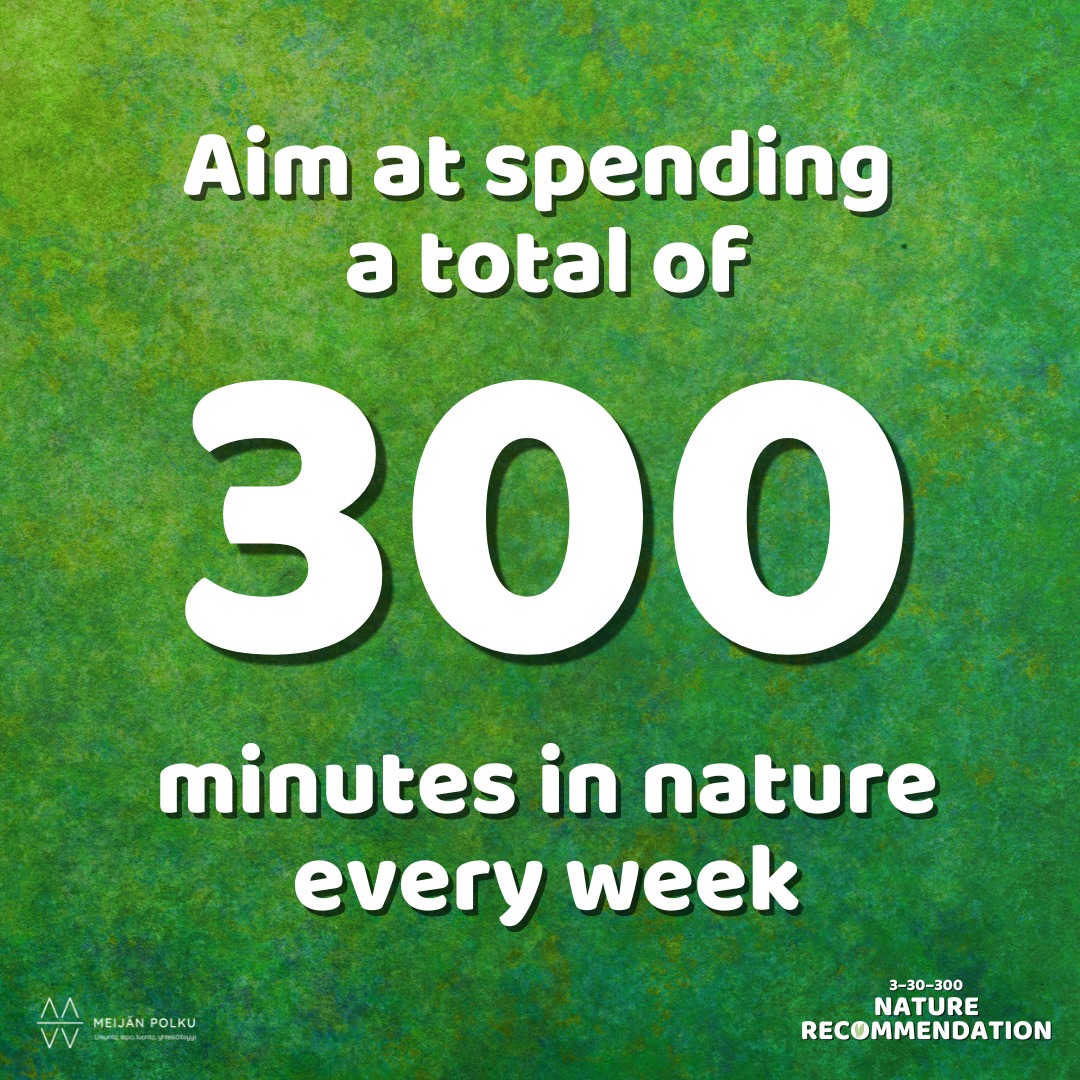
Aim to spend a total of 300 minutes in nature each week. You can do yard work, exercise, relax in a hammock, ride a bike, walk on nature trails, observe the wonders of nature or play yard games. The most important thing is to spend time in nature – in your own way!
NATURE ACROSS THE LIFE COURSE
Increasing regular contact with nearby, biodiverse nature benefits people of all ages. Accessible green and blue environments support physical health, mental well‑being and immune function throughout the life course.
Nature‑based solutions also help societies adapt to challenges such as climate change, urban heat and population ageing. In addition, opportunities to actively participate in ecological restoration and biodiversity enhancement should be promoted, allowing people to contribute to the health of natural environments while strengthening their own connection to nature and fostering social cohesion within communities.
Nature connection develops and strengthens in early childhood. Young children benefit especially from frequent, varied and hands‑on interactions with nature.
Integrate nature into everyday life through families, caregivers and early childhood education
Green daycare yards by adding forest soil, diverse vegetation and natural materials
Ensure safe and easy access to nearby natural environments
Support nature contact in home environments by increasing biodiversity and bringing natural elements into yards, gardens and shared residential spaces
For school‑aged children, nature contact supports learning, physical activity, emotional regulation and independent action.
Make nature part of the daily school routine (e.g. outdoor classes and regular outdoor learning)
Ensure green schoolyards and nature‑rich break areas
Encourage active and safe school travel through green routes and supportive mobility environments
Support and enable families to spend more time in nature together and strengthen everyday nature contact
Promote opportunities for self‑directed exploration, play and learning in natural environments
Although most young people still spend time in nature, adolescence is often a period when both physical activity and nature contact decrease.
Provide easily accessible, appealing and biodiverse natural environments near schools and study settings
Encourage short but regular nature visits
Combine nature contact with social activities and active movement
Enable and support participation in nature‑based hobbies and activities that are meaningful and appealing to young people
Create inviting learning and leisure environments where contact with nature occurs naturally as part of everyday life
Encourage active mobility and reduce reliance on passive transport (e.g. scooters and car transport), especially in everyday travel
Strengthen safe, attractive and nature‑rich routes for daily movement
For working‑age adults, increased nature contact can significantly improve perceived well‑being and health.
Support active commuting (e.g. walking or cycling) through green and nature‑rich environments that offer everyday exposure to nature.
Promote nature‑based hobbies and recreation
Encourage workplace practices such as walking meetings, outdoor workdays and working in nature
Increase awareness of the health and well‑being benefits of natural environments
Enable participation in activities that enhance biodiversity and support ecological restoration in both home environments and the wider community
Encourage workplaces to increase opportunities for nature contact in both indoor and outdoor environments
As functional capacity changes with age, accessible, safe and well‑maintained nearby nature becomes increasingly important.
Ensure barrier‑free access to green spaces close to home
Maintain high‑quality, year‑round walking paths and resting places
Support social outdoor activities, group excursions and intergenerational nature experiences
Promote gardening and yard work as meaningful forms of nature contact
Increase biodiversity in nearby home environments and residential surroundings
Provide information on the health and well‑being benefits of nature, as well as on accessible nearby nature destinations
Improve public transport connections to natural areas (“nature stops”) to enable safe and sustainable access
3–30–300 Nature Recommendation poster
You can download the A3-sized poster (PDF) to your computer and print it, for example, in waiting rooms to remind you of the importance of spending time in nature and being active in promoting well-being and health.
The poster also makes it easier to discuss the topic with different customer groups.
Every moment spent in natural environments offers us various well-being and health benefits. The aim of the 3–30–300 Nature Recommendation is to inspire us to spend time and move in natural environments as often as possible, but at least three times a week. This enables the well-being benefits we get from natural environments, which are based on frequent and regular contact with nature (Tyrväinen, 2023).
Going out to nature several times a week also enables new positive habits to form and become part of everyday life, as well as enables the accumulation of the amount of active movement recommended in the Physical activity guidelines.
Humans derive wellbeing and health benefits from nature through different mechanisms. The time spent in diverse natural environments and the frequency and recurrence of exposure to nature are important from the perspective of increased wellbeing. This is why the 3-30-300 Nature Recommendation advises people to visit natural environments at least 3 times a week for at least 30 minutes at a time and sets the weekly target of 300 minutes in totalMost people’s contacts with nature in Finland take place in their local environments, or less than 300 metres from home. However, a visit to natural sites further away from home usually lengthens the duration of individual visits and also enables new experiences of nature activities and outdoor exercise.
Nature Recommendation in Finland
We Finns are known as a ‘people of nature’. However, our relationship with nature is very dispersed and different, for example, depending on where we live and age group. About four percent of us don’t go out in nature at all, and 700,000 Finns go outside less often than once a week (LVVI3). At the European level, things are even worse in terms of physical activity. Almost half of Europeans do not do any kind of exercise (Special Eurobarometer 525).
Due to urbanization, the use of cars and our changed lifestyles, our contact with diverse nature has decreased significantly. We suffer from Nature-deficit disorder, the effects of which can be seen, for example, in the prevalence of lifestyle diseases, such as heart and circulatory system diseases, type 2 diabetes and some cancers. Increasing the amount of time spent in nature has an ever-increasing importance not only in terms of public health, but also in terms of the national economy. (Tyrväinen et al., 2024)
The costs of immobility and sedentary lifestyles in Finland have been estimated at approximately 3.2–7.5 billion euros per year, and the amount is expected to increase as the population ages and morbidity increases. (Vasankari et al. 2018) The number of people suffering from mental health problems is also growing in Finland, and the costs of work absences and disability pensions alone are estimated to be over 2 billion euros per year. (Kestilä et al. 2025) If we were to multiply the above figures by the population of Europe, for example, we would already be talking about several hundred billion euros per year.
More and more research shows that spending time in nature and being physically active both boost our well-being and health. These benefits start quickly and become even greater the more time we spend outdoors and moving. But how much is ‘more’?
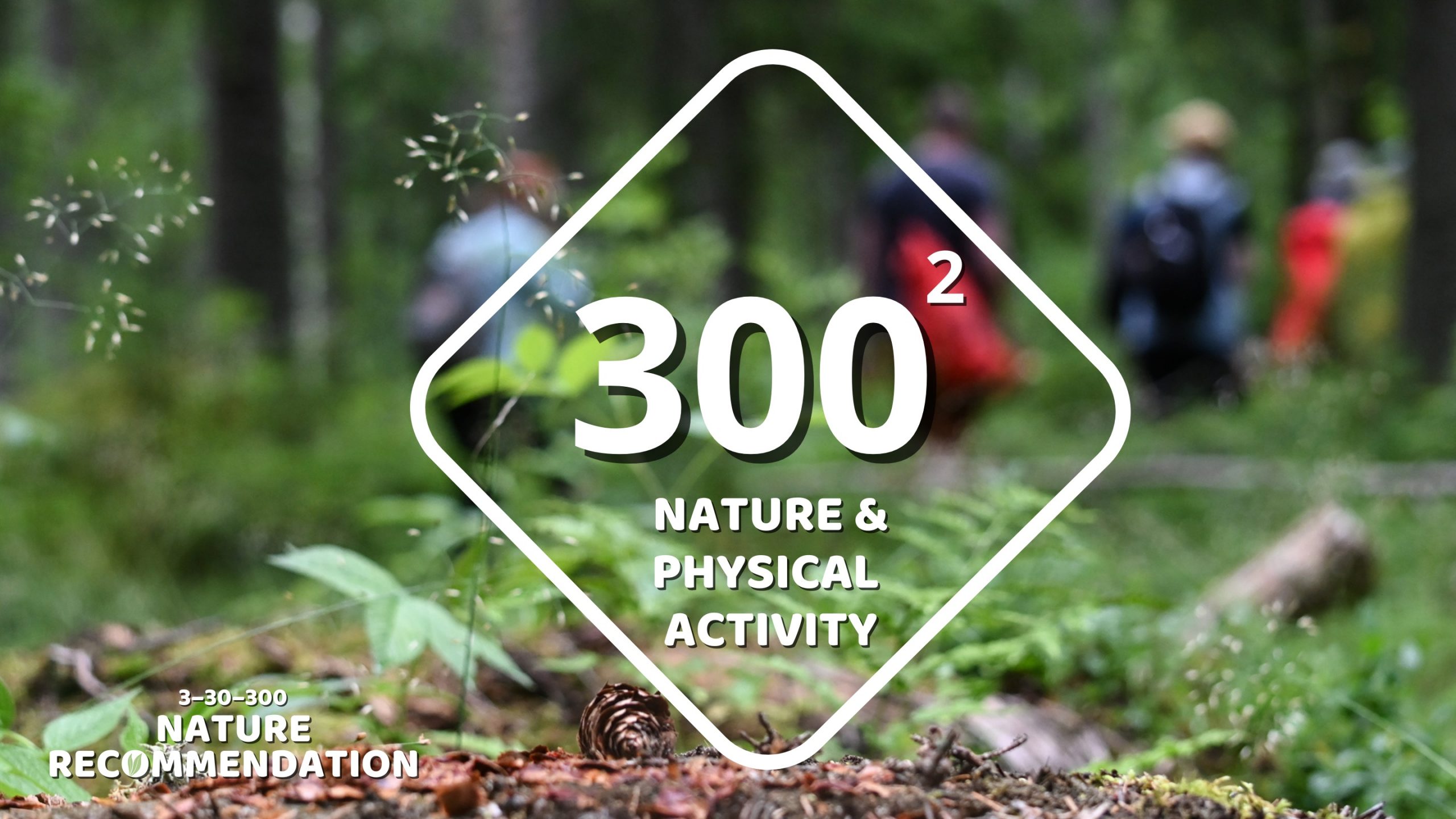
As stated in the 3–30–300 Nature Recommendation, 300 minutes a week would be the optimal goal for the time spent in nature. As the Physical Activity Guideline for adults recommends at least 150 minutes of moderate aerobic activity a week, it also states that for even more health benefits, one should aim for 300 minutes a week.
If we want a better future, one of the best things we can do is spend 300 minutes each week being active in nature. Picture a society with fewer preventable diseases, significantly lower healthcare costs, and people living longer, happier lives—all from adding some outdoor activities in their lives. In addition, when we spend more time outdoors, we improve our connection to nature. This connection is crucially important not only for our well-being but also for the well-being of the planet.
300 times 3
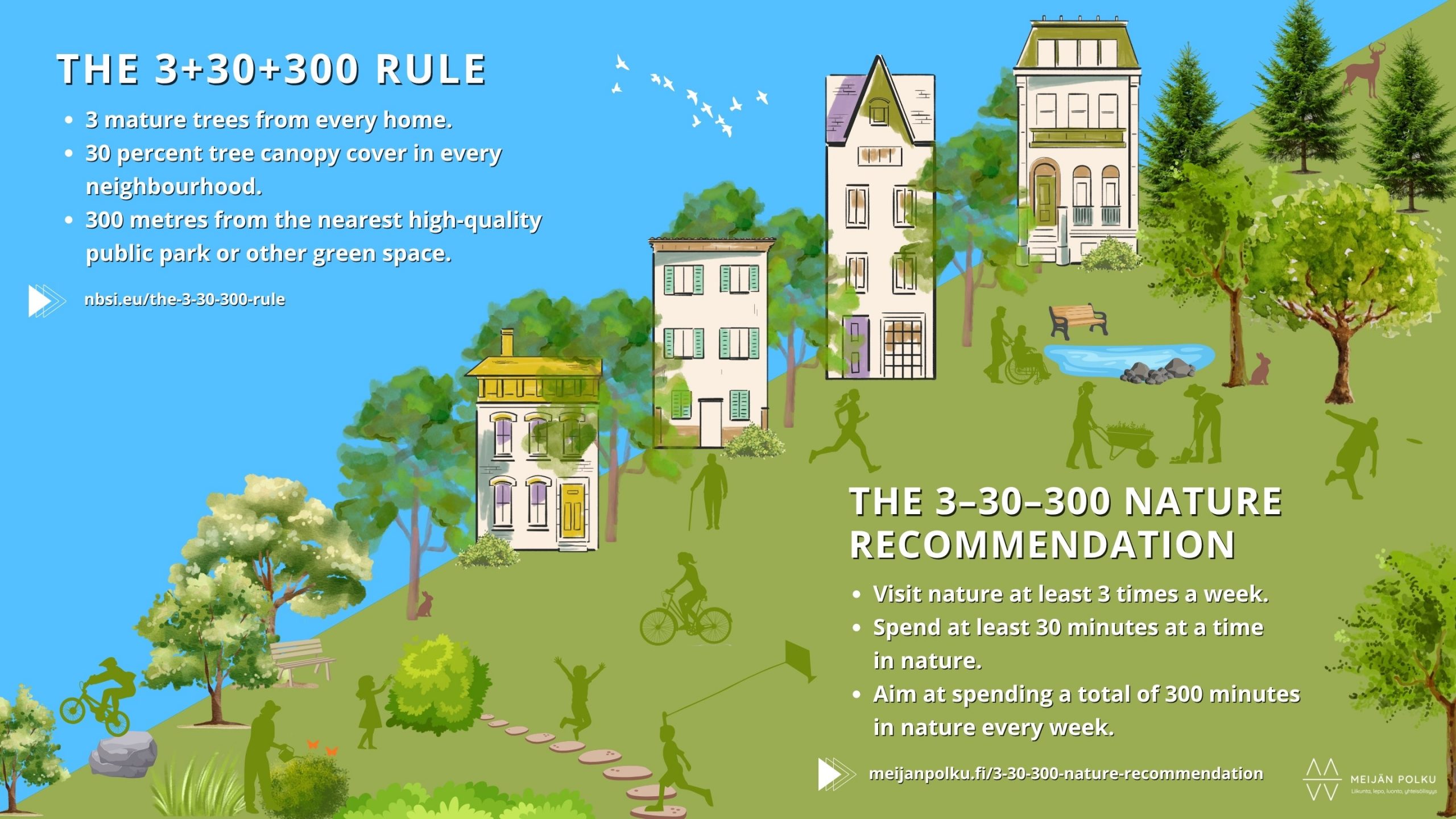
To help people be physically active in nature for 300 minutes a week, we need to address a few key issues in our communities. First, we should make it easier for people to be active by improving the safety and appeal of walking, cycling, and public transport, and reducing our reliance on cars. Second, we need to add larger green spaces close to homes. And here is where the original 3–30–300 rule by Cecil Konijnendijk comes in: everyone should live within 300 meters of a large public green space. Third, we need to make outdoor activities and active transportation the next ‘big thing’.
If we can meet these goals across the population, we will have a society where physical and mental health are constantly improving. And at the same time, we are creating habitats where we can all thrive.
If you can combine the 3+30+300 Rule and the 3–30–300 Nature Recommendation you are on the right track towards future cities and wellbeing.
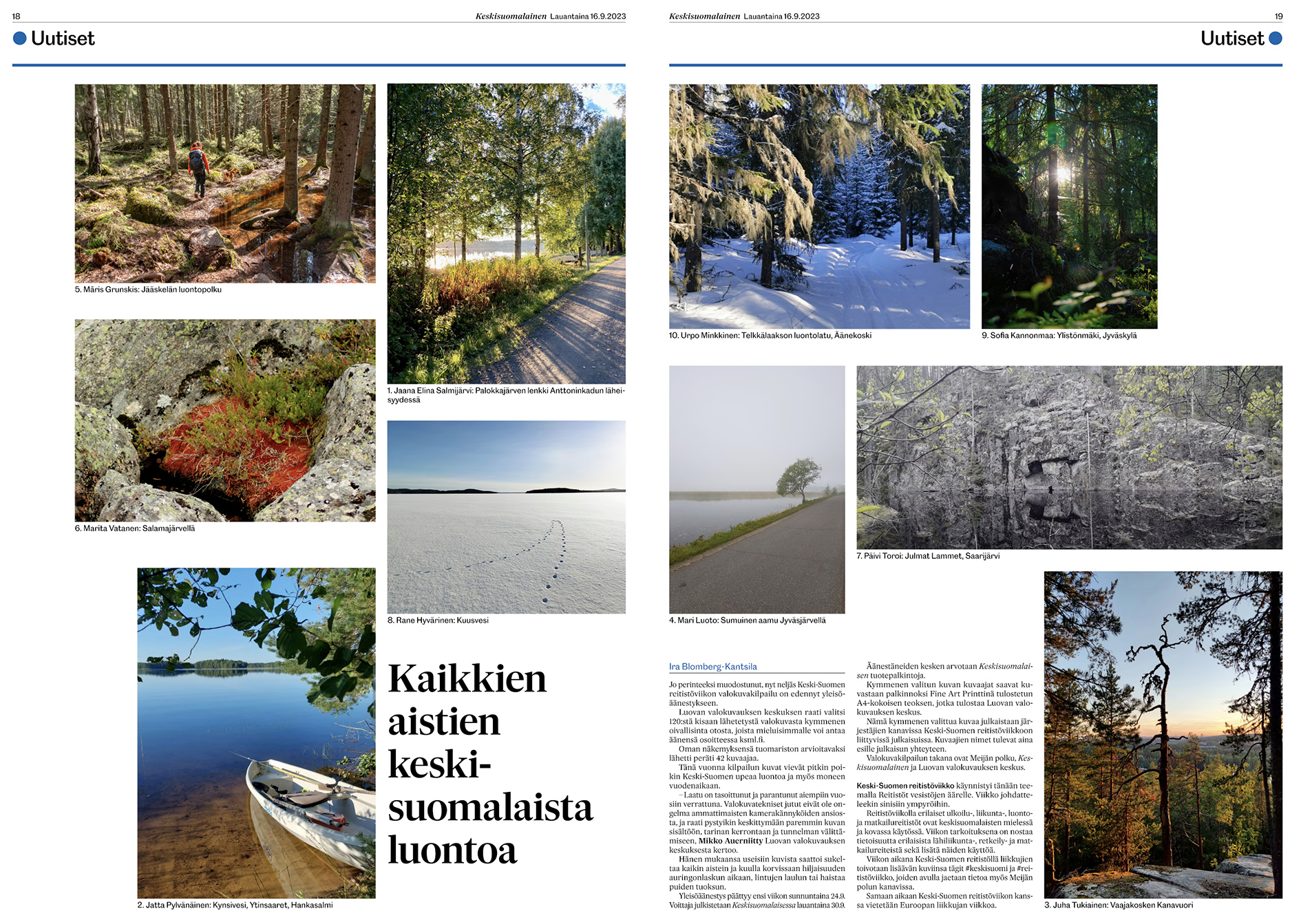
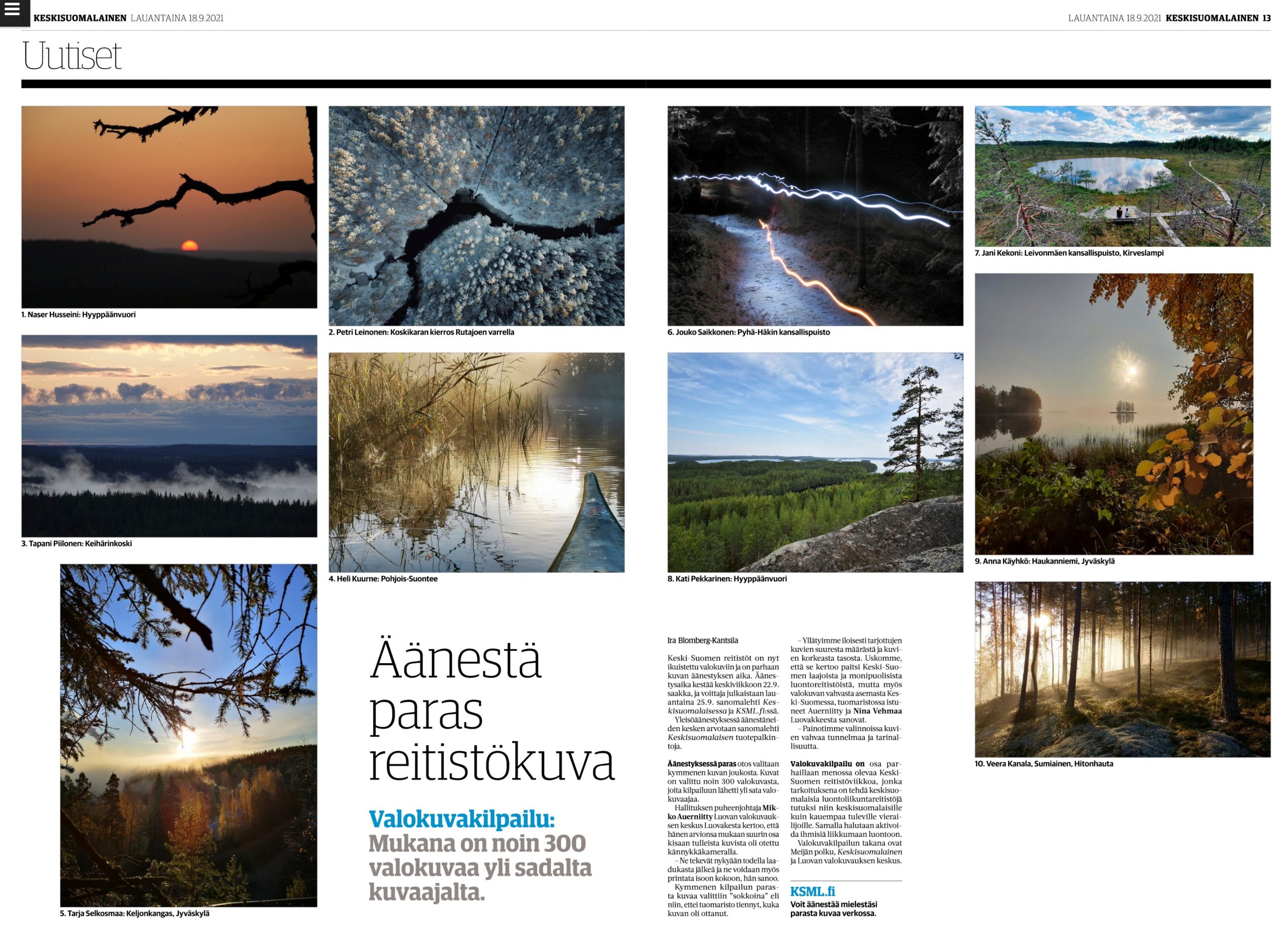
Keski-Suomen reitistöviikolla järjestettiin kaikille avoimia valokuvakilpailuja vuosina 2021–2024 yhteistyössä sanomalehti Keskisuomalaisen ja Luovan valokuvauksen keskuksen kanssa.
Syyskuussa 2024 yleisöäänestyksessä ääniä annettiin 958, joista 247 sai kannonkoskelaisen Pekka Viljakaisen kuva sumuisesta lähimetsästään. Toiseksi äänestettiin Hannele Polun kuva Jyväskylän Haukanniemestä ja kolmanneksi Marjaana Kokin kuva Koskikaran kierrokselta Leivonmäen kansallispuistosta.
Aiemmilla kerroilla voittajiksi on äänestetty Juha Tukiaisen auringonlasku Jyväskylän Kanavuorelta (2023) Mikko Voutilaisen kuva Salamajärven kansallispuistosta Hirvaan kierroksen varrelta (2022) ja Anna Käyhkön kuva Jyväskylän Haukanniemestä (2021). Alla kymmenen kuvan kärki Keskisuomalaisessa vuosilta
Olemme toteuttaneet yhteistyössä kansainvälisen Outdoor Office Day -verkoston kanssa julistesarjan muistuttamaan luontoympäristöissä oleskelun ja liikkumisen merkityksestä aivoillemme. Alta voi tulostaa A3-kokoisen julisteen toimiston seinälle tai kahvihuoneeseen kuljettamaan ajatuksia ja niitä tuottavia aivoja luontoympäristöihin.